Home workout without equipment: a 30-day plan for beginners
A complete 30-day home workout plan with no equipment: bodyweight exercises for chest, legs, back and core, how to progress, how to use household items, and how to stay consistent.
Key points
- You can build real strength at home with push-ups, squats, lunges, rows, glute bridges and planks, and no equipment.
- Train 3–4 days a week, full-body, with rest days in between.
- Progress every week: more reps, slower reps, harder variations or shorter rest.
- Add daily walking, and follow the WHO advice of at least 150 minutes of moderate activity a week.
No gym nearby, no money for a membership, or no time to travel? No problem. A small space at home, or on the roof, is enough to get stronger, fitter and more confident.
This 30-day plan uses only your body weight and a few household items. It's designed for beginners, and it follows the basic principles of strength training: work the major muscle groups, rest, and gradually make it harder.
What you need
- A space about the size of a prayer mat
- A sturdy chair or bed edge
- A towel
- Optional: a backpack you can fill with books, and a couple of filled water bottles
Warm-up (5 minutes, before every session)
- March or jog on the spot: 1 minute
- Arm circles: 30 seconds forwards, 30 seconds backwards
- Bodyweight squats, slow: 10
- Hip circles: 10 each way
- Inchworms (walk hands out to a plank and back): 5
- Jumping jacks or step-jacks: 30 seconds
The core exercises
Lower body
- Squat: feet shoulder-width apart, sit back as if onto a chair, chest up, knees tracking over toes, then stand.
- Reverse lunge: step one foot back and lower until both knees are bent at about 90 degrees, then return.
- Glute bridge: lie on your back, knees bent, and lift your hips until your body forms a straight line from shoulders to knees.
- Step-ups: onto a sturdy step or low bench.
Upper body: push
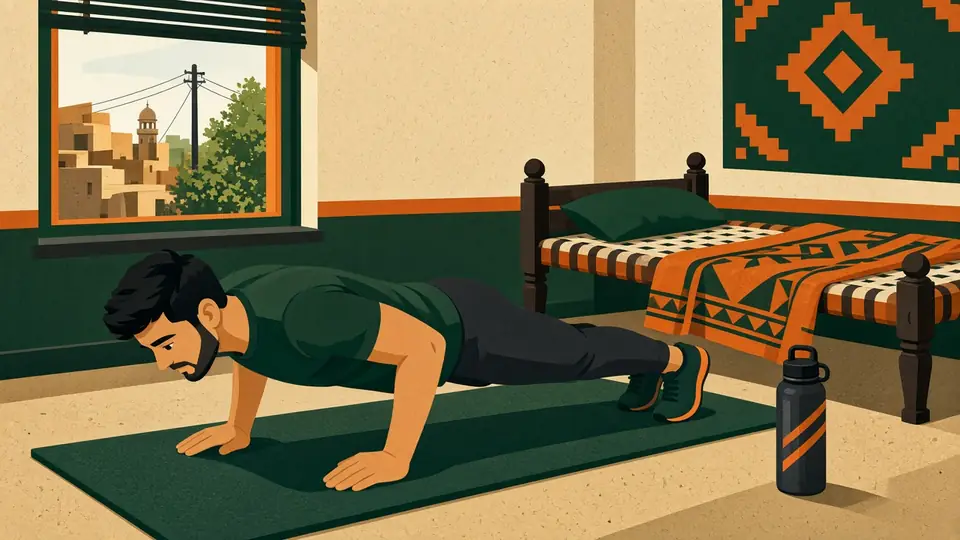
- Push-up: body in a straight line, lower your chest towards the floor, and push back up.
- Easier: hands on a wall, table or bed edge (incline push-up), or knees on the floor.
- Harder: feet raised on a chair (decline push-up).
- Chair dips: hands on the edge of a sturdy chair behind you, lower and push back up. Keep it shallow if your shoulders feel uncomfortable.
Upper body: pull
Pulling exercises are the hardest to do without equipment, but they're important for posture and balance.
- Table row: lie under a sturdy table, grip the edge, and pull your chest up towards it, keeping your body straight. Make sure the table is strong and stable.
- Towel row: loop a towel around a strong door handle (open the door, and hold both ends with the door between your feet), lean back and pull yourself in. Check the door and handle are secure.
- Backpack row: bend forwards at the hips, back flat, and row a loaded backpack towards your stomach.
- Superman / back extension: lie face down and lift your chest and legs slightly.
Core
- Plank: forearms and toes, body straight, squeeze your stomach and glutes.
- Dead bug: lie on your back, arms up and knees bent at 90 degrees, then slowly extend the opposite arm and leg.
- Side plank: on one forearm, hips up.
The 30-day plan
Train on Days 1, 3 and 5 of each week (for example Monday, Wednesday and Friday), and add a 4th session in weeks 3–4 if you feel good. On other days, walk for 30 minutes.
Do the exercises as a circuit: one set of each, then rest 1–2 minutes and repeat.
Week 1 (Days 1–7): learn the movements, 2 rounds
| Exercise | Reps |
|---|---|
| Squats | 10 |
| Incline push-ups (hands on a bed or table) | 8 |
| Glute bridges | 12 |
| Table or backpack rows | 8 |
| Reverse lunges | 6 each leg |
| Plank | 20 seconds |
Week 2 (Days 8–14): build volume, 3 rounds
| Exercise | Reps |
|---|---|
| Squats | 12–15 |
| Push-ups (incline or knees, or full if you can) | 8–10 |
| Glute bridges | 15 |
| Rows | 10 |
| Reverse lunges | 8 each leg |
| Superman holds | 3 × 5 seconds |
| Plank | 30 seconds |
Week 3 (Days 15–21): harder variations, 3 rounds
| Exercise | Reps |
|---|---|
| Slow squats (3 seconds down) or backpack squats | 12 |
| Full push-ups | As many as possible with good form (stop 1–2 before failure) |
| Single-leg glute bridges | 10 each leg |
| Rows (feet further forward to make it harder) | 10–12 |
| Step-ups | 10 each leg |
| Chair dips | 8–10 |
| Side plank | 20 seconds each side |
Week 4 (Days 22–30): challenge, 3–4 rounds
| Exercise | Reps |
|---|---|
| Split squats (back foot on the floor, or raised on a chair for advanced) | 10 each leg |
| Push-ups (try decline if full push-ups are easy) | Max with good form |
| Single-leg glute bridges | 12 each leg |
| Rows | 12 |
| Reverse lunges with backpack | 10 each leg |
| Chair dips | 10–12 |
| Dead bugs | 10 each side |
| Plank | 45 seconds |
On Day 30, test yourself: how many push-ups and squats can you do with good form? Compare with Day 1.
How to keep progressing after 30 days
Your muscles adapt, so keep making the work harder:
- Add reps or rounds
- Slow down the lowering phase (3–4 seconds)
- Move to harder variations (for example, pistol squat progressions, archer push-ups)
- Add load with a backpack of books
- Shorten rest periods
If you want to move to the gym later, our 12-week body banane ka tarika is the natural next step.
Cardio and daily movement
The WHO recommends adults get at least 150–300 minutes of moderate activity a week, plus muscle strengthening on 2 or more days. Walking, climbing stairs, skipping rope (if you have space) and playing cricket or football all count.
Diet matters too
Exercise builds strength, but food determines whether you gain muscle, lose fat, or both. Aim for enough protein (eggs, milk, dahi, daal, chana, chicken) and adjust calories to your goal. See our gym diet plan for Pakistani men.
Staying consistent
- Schedule it like a meeting. Morning before work, or after Maghrib, works for many people.
- Track your reps in a notebook or on your phone.
- Train with a brother, cousin or friend, even by video call.
- Don't wait for motivation. Start with just the warm-up; once you've started, you'll usually finish.
- Exercise in cooler hours during the Pakistani summer, and drink water.
See a doctor promptly if
- You have chest pain, severe breathlessness, dizziness or palpitations during exercise. Stop and seek medical care.
- You have heart disease, uncontrolled high BP, or a recent injury or operation.
- Joint pain gets worse with each session rather than better.
Frequently asked questions
Can I build muscle with home workouts?
Yes, especially as a beginner. Bodyweight exercises can build significant strength and muscle if you progressively make them harder and eat enough protein.
How many days a week should I work out at home?
Three to four full-body sessions a week, with rest days in between, is ideal for beginners. Walking on other days is a good addition.
How long should a home workout take?
About 25–40 minutes, including the warm-up, is enough for this plan.
Can I lose belly fat with home workouts?
Exercise helps, but you can't target fat loss from one area. Belly fat reduces with overall fat loss, which depends mainly on diet, plus exercise and sleep.
What if I can't do a single push-up?
Start with wall or table push-ups, and gradually lower the height. Most people can do full push-ups within a few weeks.
Sources
- World Health Organization. WHO guidelines on physical activity and sedentary behaviour, 2020.
- World Health Organization. Physical activity fact sheet.
- NHS. Strength exercises.
- American College of Sports Medicine. Progression models in resistance training for healthy adults (position stand). Medicine & Science in Sports & Exercise, 2009.
- Kikuchi N, Nakazato K. Low-load bench press and push-up induce similar muscle hypertrophy and strength gain. Journal of Exercise Science & Fitness, 2017.
Sources were checked on 26 November 2026. Found an error? Tell us and we will correct it.
Medical disclaimer: This article is general information, not a diagnosis or treatment plan. Please talk to a qualified doctor about your own situation. Read our full disclaimer.