Body banane ka tarika: a 12-week beginner gym plan that actually works
Body banane ka sahi tarika for beginners: a complete 12-week gym plan with exercises, sets and reps, progressive overload, desi diet basics, sleep, and realistic expectations without steroids.
Key points
- Muscle is built by three things: progressive resistance training, enough protein and calories, and sleep. Nothing else comes close.
- Beginners grow fastest with full-body training 3 days a week, focused on big compound lifts.
- Progressive overload, adding a little weight or a few reps over time, is the single most important principle.
- Realistic natural progress for a beginner is roughly 0.5–1 kg of muscle per month in the first year, often less. Anyone promising more is probably selling steroids.
"Bhai, body kaise banaun?" Every beginner asks this, and most get one of two answers: copy a bodybuilder's 6-day routine from YouTube, or "le lo yeh injection, ek mahine mein body ban jayegi". The first leads to burnout and injury. The second can damage your heart, liver and hormones. See our warning on weight gain tablets and steroids.
This is a simple, proven, 12-week beginner plan, based on the training principles recommended by sports science bodies such as the American College of Sports Medicine. You need access to a basic gym.
The three things that build muscle
- Training: lifting weights with enough effort, and gradually doing more over time
- Nutrition: enough protein (around 1.6 g per kg body weight per day) and enough calories
- Recovery: 7–9 hours of sleep and rest days
Miss any one of these and progress stalls.
Before you start
- Warm up for 5–10 minutes: light cycling or brisk walking, then a few light sets of your first exercise.
- Learn the movements with light weight. Ask a qualified trainer to check your form on squats, deadlifts and bench press.
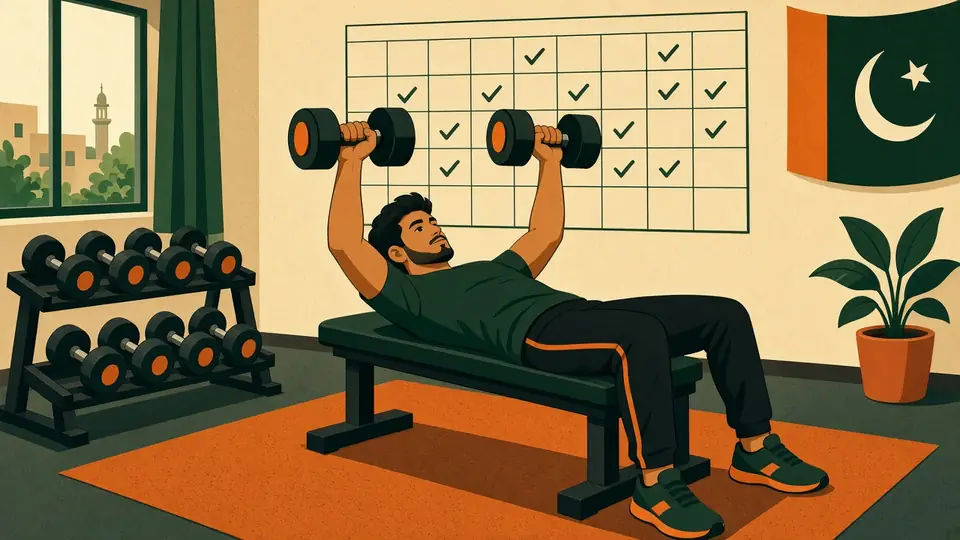
- Keep a training log in a notebook or on your phone. Write down every exercise, weight and rep. This is how you make sure you're progressing.
The 12-week plan
Train 3 days a week, on non-consecutive days (for example Monday, Wednesday and Friday). Each session is full-body.
Weeks 1–4: learn and build the base
Alternate between Workout A and Workout B.
Workout A
| Exercise | Sets × reps |
|---|---|
| Goblet squat or barbell back squat | 3 × 8–10 |
| Dumbbell or barbell bench press | 3 × 8–10 |
| Seated cable row or dumbbell row | 3 × 10–12 |
| Romanian deadlift (light) | 2 × 10 |
| Plank | 3 × 20–30 seconds |
Workout B
| Exercise | Sets × reps |
|---|---|
| Leg press or split squat | 3 × 10–12 |
| Overhead dumbbell press | 3 × 8–10 |
| Lat pulldown or assisted pull-up | 3 × 10–12 |
| Hip thrust or glute bridge | 2 × 12 |
| Dumbbell curls + triceps pushdowns | 2 × 12 each |
Rest 1.5–2 minutes between sets of big exercises and about 1 minute for smaller ones.
Effort: finish each set feeling you could do only 2–3 more reps with good form.
Weeks 5–8: add load
Keep the same exercises, but:
- Move to 4 sets on your first two exercises of each workout.
- Use progressive overload: when you can do the top of the rep range (for example 10 reps) for all sets with good form, add weight next session, typically 2.5 kg for lower body or 1–2.5 kg for upper body.
- Introduce the conventional deadlift in Workout B (3 × 5) with a weight that feels moderate, if a trainer has checked your technique.
Weeks 9–12: build strength and size
- Compound lifts: 4 × 6–8 (heavier).
- Accessories: 3 × 10–15.
- Add one extra set of rows or pulldowns, because most beginners need more back work.
- Week 12: reduce sets by about half for a lighter recovery week, then test how much stronger you've become.
After 12 weeks, you can continue progressing on this plan or move to a 4-day upper/lower split.
Progressive overload: the golden rule
Your muscles grow when they're challenged a little more over time. You can progress by:
- Adding weight
- Adding reps at the same weight
- Adding a set
- Improving your form and control
If your training log looks the same week after week, your body will too.
Diet for body banana
Read our full gym diet plan for Pakistani men. The essentials:
- Protein: about 1.6 g/kg/day. A 65 kg man needs around 105 g: for example, 4 eggs, 2 glasses of milk, a bowl of daal and 150 g of chicken.
- Calories: eat a little more than you burn. If the scale doesn't move in 2–3 weeks, add a roti, a glass of milk or a handful of peanuts.
- Don't skip meals. Three meals and one or two snacks is a good pattern.
If you're very skinny, see our weight gain diet.
Sleep and recovery
- 7–9 hours of sleep. Late nights on the phone are the silent enemy of gains.
- Rest days are when muscle repairs and grows. Walking on rest days is fine.
- Muscle soreness in the first weeks is normal and fades as your body adapts.
Realistic expectations
- In the first 4–8 weeks, much of your strength gain comes from your nervous system learning the movements.
- Visible muscle growth usually starts after about 6–8 weeks of consistent training.
- Natural beginners typically gain roughly 0.5–1 kg of lean muscle per month in the first year, if diet and sleep are good, and the rate slows after that.
Social media physiques built in "3 months" are often the result of years of training, good lighting, or steroids. Compare yourself only with your own log.
Common beginner mistakes
- Ego lifting: too much weight with bad form leads to injury
- Changing programmes every week
- Not eating enough, especially protein
- Training the same muscle every day, without rest
- Skipping legs
- Relying on supplements instead of food and training
- Comparing yourself with people who may be using steroids
Can I build muscle at home?
Yes, especially as a beginner. Push-ups, squats, lunges and rows with household items can build a solid base. See our 30-day home workout without equipment.
Tracking your progress
What gets measured gets managed. Keep it simple:
- Training log: write down exercises, weight, sets and reps for every session, in a notebook or a phone app. If the numbers slowly go up, you're making progress.
- Body weight: weigh yourself a few times a week, in the morning, and look at the weekly average. Daily weight jumps around with water and food.
- Measurements: chest, arms, waist and thighs every 4 weeks.
- Photos: front, side and back every 4 weeks, in the same light.
When to adjust
- Strength going up, weight stable, waist stable: great, keep going.
- Weight not moving for 3–4 weeks and you want to gain: add a little more food, such as an extra glass of milk or a serving of daal and rice.
- Waist increasing quickly: you may be gaining more fat than needed; trim the extras slightly.
- Strength stuck for several weeks: check sleep, food and recovery; consider a lighter week or a change of rep range.
Progress is rarely a straight line. Look at the trend over months, not days.
See a doctor promptly if
- You have chest pain, severe breathlessness, dizziness or fainting during exercise.
- You have a heart condition, high blood pressure that isn't controlled, or a previous serious injury.
- You feel sharp joint pain (not normal muscle soreness) that doesn't settle after a few days of rest.
Frequently asked questions
How long does it take to build a body?
You'll feel stronger within weeks and usually see visible changes after 2–3 months of consistent training, eating and sleeping. Significant change takes a year or more.
How many days a week should a beginner go to the gym?
Three full-body sessions a week is enough for most beginners to make excellent progress.
Can I build muscle without supplements?
Yes. Food, training and sleep build muscle. Supplements like whey or creatine are optional extras.
Should I do cardio while building muscle?
Some cardio, like walking or 2–3 short sessions a week, is good for your heart and won't stop muscle growth if you eat enough.
Is it safe to lift weights at 16 or 17?
Supervised resistance training with proper technique is considered safe and beneficial for teenagers. Avoid maximal lifts without supervision, and never use steroids.
Sources
- American College of Sports Medicine. Progression models in resistance training for healthy adults (position stand). Medicine & Science in Sports & Exercise, 2009.
- World Health Organization. WHO guidelines on physical activity and sedentary behaviour, 2020.
- Schoenfeld BJ, et al. Resistance training volume enhances muscle hypertrophy but not strength in trained men. Medicine & Science in Sports & Exercise, 2019.
- Morton RW, et al. Protein supplementation and resistance training-induced gains in muscle mass and strength. British Journal of Sports Medicine, 2018.
- NHS. Strength exercises.
Sources were checked on 26 November 2026. Found an error? Tell us and we will correct it.
Medical disclaimer: This article is general information, not a diagnosis or treatment plan. Please talk to a qualified doctor about your own situation. Read our full disclaimer.